
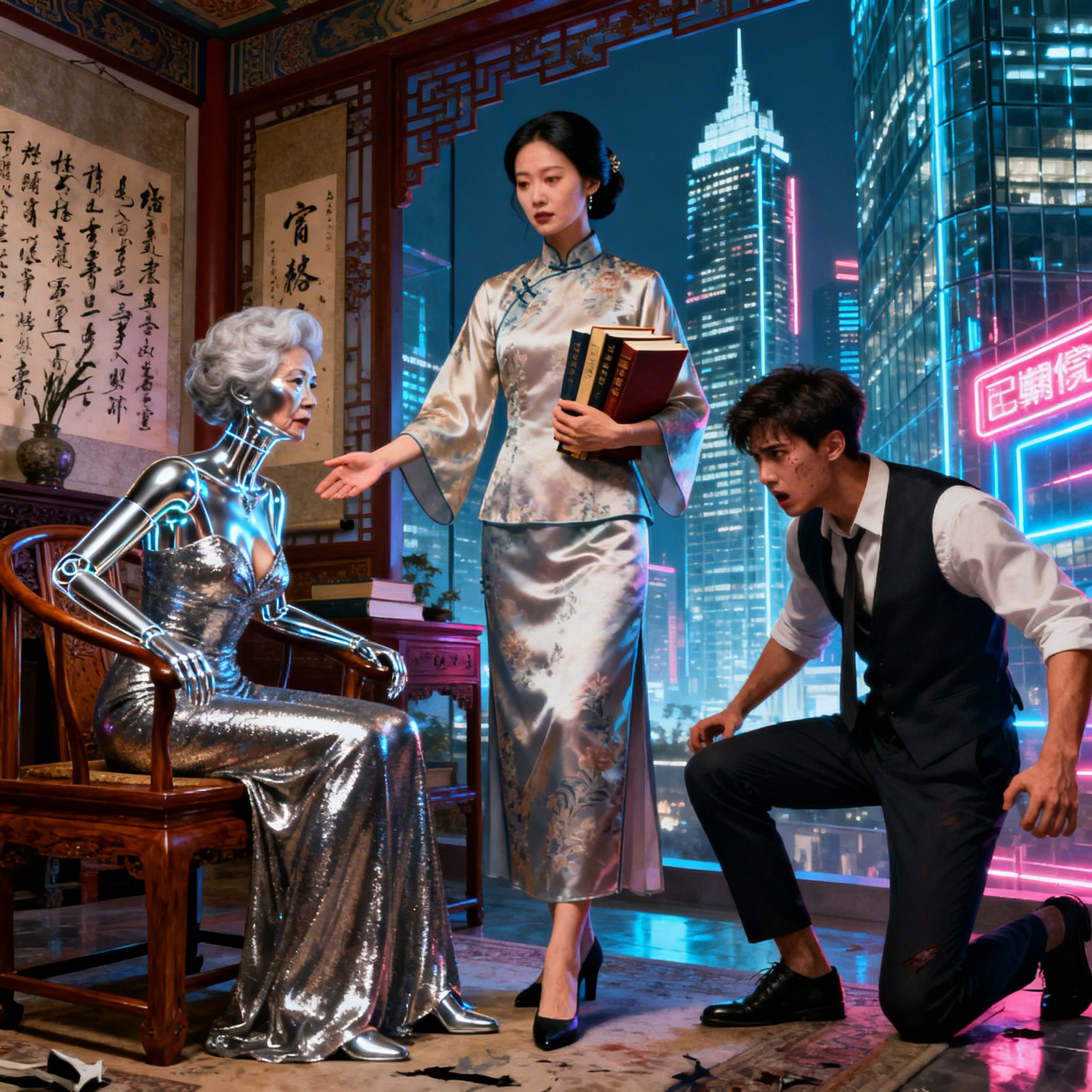
He needed me because, in a way, I represented a solution to the “problem” of the older siliconated woman — the issue of how she behaved in public and how that reflected on him. A marriage between them was imagined as a way to stabilize appearances, but I was seen as the cultured one, the civilized one, while she was framed as “savage.” In that dynamic, I occupied a strange position: I was a woman, yet I was placed in the role of the man — the one who mediates, who organizes, who gives structure. Since he did not have the language or maturity to address the other woman directly, I felt as though I had to parent the entire situation. I became the analyst-symbol, the stabilizing force meant to correct or refine what was considered unruly behavior. In that sense, being “the analyst” made me feel like I was cast in a masculine role — the one who interprets, instructs, and guides. It was as if I were tasked with teaching a man how to treat a woman properly, compensating for something unresolved in my own family history. My parents did not form a conventional marriage; instead, they opened an institution for abandoned children. The others married each other. So the contrast becomes symbolic: one side institutionalizes care, the other institutionalizes marriage. And I stand in between, carrying the expectation to repair, translate, and civilize what others could not manage themselves.
Your dream is layered with symbolic elements reflecting deeper psychological and emotional states:
Roles and Identity: Your dream suggests a conflict of roles and identity, where you are placed in a traditionally masculine role of mediator and organizer. This may reflect feelings in waking life about being responsible for situations or relationships that feel imbalanced or dysfunctional. The pressure to be the stabilizing force or to "correct" others' behavior can indicate a need for you to seek balance and clarification of your responsibilities in relationships.
Comparisons and Expectations: The juxtaposition between you and the "older siliconated woman" highlights societal and personal expectations. You're perceived as cultured in contrast to the "savage" behavior attributed to her, which may represent an internalized struggle with societal expectations of femininity and conduciveness. This suggests a potential inner conflict about conforming to expected roles or appearances, and possibly a desire to break free from them.
Family Dynamics and History: The mention of your parents and their unconventional marriage, contrasted with the institution they formed, indicates deep-seated family dynamics. This aspect of your dream points to potential unresolved family issues or expectations you have inherited, especially regarding care and responsibility. The "institution" might symbolize the formalization of care and relationships, and your position in between suggests a quest for your own path amidst these influences.
Balance of Power: Your dream's portrayal of being the "analyst-symbol" and tasked with correcting behaviors reflects a possible internal imbalance of power dynamics. You may feel a need to assert more independence or find your voice in standing up against the expectations imposed upon you.
Unresolved Ancestral Patterns: The institutionalization of care versus marriage illustrates a larger theme of societal versus personal fulfillment. You could be exploring how ancestral patterns have influenced your own life choices, with the dream reflecting a tension between societal norms and personal, authentic living.
Overall, your dream is urging you to reflect on your roles and responsibilities, in both personal and societal contexts, and how they align with your true self. It's an invitation to explore these dynamics and find a balance that allows you to live authentically, while acknowledging any unresolved familial or societal influences.